
Go Big
How top brands are winning the content game — and 3 content strategies to try this week.

My friends and I have a special tradition: On each of our birthdays, we share three lessons we learned the previous year — ideally on a beach at 2 am while clutching a bottle of champagne. Some gems:
Day 3 of the bender is when everything breaks.
Never plan to get anything done on a plane.
Fireball on the Rocks is a funny drink order, but it is not a sustainable lifestyle choice.
Back up your iPhone BEFORE you go to the Apple Store.
You’ll never be glad you wore stilettos.
Always fly direct.
One edible is enough.
No one cares if you don’t go to the party.
Never eat street fish.
Write these down. It’s absolutely life-changing stuff.
And guess what? It was my birthday this week, so for this week’s newsletter, I decided to share three content lessons I learned during my 37th trip around the sun.
1. Go Big
For the past eight years, marketers have been obsessed with “scaling” content across every channel and trying to create content that blends into the feed. But the brands creating winning content have taken a different approach: They’re going big and creating high-effort content that stands out in slop-filled feeds.
One huge trend: cinematic content. Burberry created a series of seven films inspired by British rom-coms. Reformation created a Hitchcock-esque film called Followed with influencer Nara Smith. And Duolingo — always on the cutting-edge of content and social strategy — created an anime series to promote its new Japanese courses.
These series are racking up tens of thousands of likes and millions of views. And they’re a way of saying, “We’re premium and we give a shit,” while competitors pollute the feed with slop. (Looking at you, J-Crew.)
On the B2B side, finops platform Ramp went big by bringing on Kevin from The Office as its CFO and livestreaming his first day from a glass-box office in the middle of NYC. It was fucking hilarious and generated 112 million views across platforms. In all of these cases, the brands are creating unique IP that they can build on for months to come.
Meanwhile, small content is dying. It has little value in a world where AI drives the cost of creating mediocre content down to zero, and our feeds are more crowded than ever. I’d much rather invest in one badass piece of content IP than produce 1,000 mediocre posts. The highest-ROI content campaigns I’ve been part of this year were State of AI Innovation research — where I interviewed 250 CTOs to reveal what’s really going wrong with AI transformation — and Pepper’s global GEO Summit, where we unveiled a new playbook for AI Search. In both cases, we created a tentpole piece of original IP that drove thousands of leads and powered a months-long campaign.
I’ve tried to “go big” in my own work, too. That’s why I spent the past four months writing a “big idea” book that’ll anchor my newsletter, videos, and speaking for the next 1-2 years.
If you want to get off the hamster wheel of chasing likes, don’t think small with your content strategy. Go big.
2. You can’t just be a writer
It’s incredibly hard to just be a writer anymore. The hard truth is that if you want to reach new people with your ideas, you need to embrace video.
I know. I can hear your UGH from here. And I get it. I love to write. But we can’t ignore it any longer. Social media has become television; we spend 90% of our time on the apps watching videos from people we don’t know. According to Spotify, video podcasts are growing 20x faster than audio-only ones. Video drives discoverability.
Sure, you can choose to be a purist and say that you’re only going to create for people who like to read. But if you want to reach as many people with your ideas as possible, it’s blindingly obvious that you need to get comfortable making vertical video.
I filmed more videos than ever last year, but I’m upping my commitment big-time this year — at least three videos per week, unless I’m in the hospital or on vacation. Hold me to it.
3. IRL is the most underrated content channel
There was one content channel that outperformed all others for me this year: IRL. In real freaking life.
When I quit my CMO job to go independent one year ago, I decided to say yes to almost everything. (I did say no to ketamine and several sketchy conferences in Florida). It paid off. My highest-paying opportunities all came from people who saw me speak. It makes sense: We’re inundated with digital slop. In-person content and experiences hit deeper. Sure, you only reach 200 people at an event vs. 20,000 online, but if you’re speaking at the right places, you a) engage the people who matter and b) make a memorable impression on them.
Pitch yourself for in-person speaking gigs. Tell stories that sear your ideas into attendees’ minds. The dirty secret is that most conference content sucks. If you have a provocative perspective and great stories to back it up, it’s easy to stand out.
3 content strategies to try this week
Industry Confessionals: One of my favorite series of the mid-2010s was Digiday’s “Confessionals” series, where they’d get CMOs, ad buyers, and agency heads to talk shit about their industry anonymously. You should steal it for your industry. It’s juicy content, made for social, and a brilliant way to build bonds with the execs and industry leaders you want to reach.
Frustration Solver: Identify a major frustration your customers face, and film a video showing how your product solves it. Rand Fishkin does this brilliantly with SparkToro and Alertmouse, his new product for tracking brand mentions. The key: Use the frustration as the hook — in this case, why doesn’t Google actually deliver my brand alerts?!
The Anti-Playbook: Take industry “best practices” that you know don’t work and rip them to shreds. Here’s another excellent example from Rand: “Don’t Start Your Content Marketing With ‘What Do My Customers Want?”
If you liked this, you’ll also like:
Recommended
One Vigilante, 22 Cell Tower Fires, and a World of Conspiracies (Brandan Koerner / Wired): A delightful weekend read about how one Joe Rogan episode spawned the world’s most prolific 5G tower arsonist.
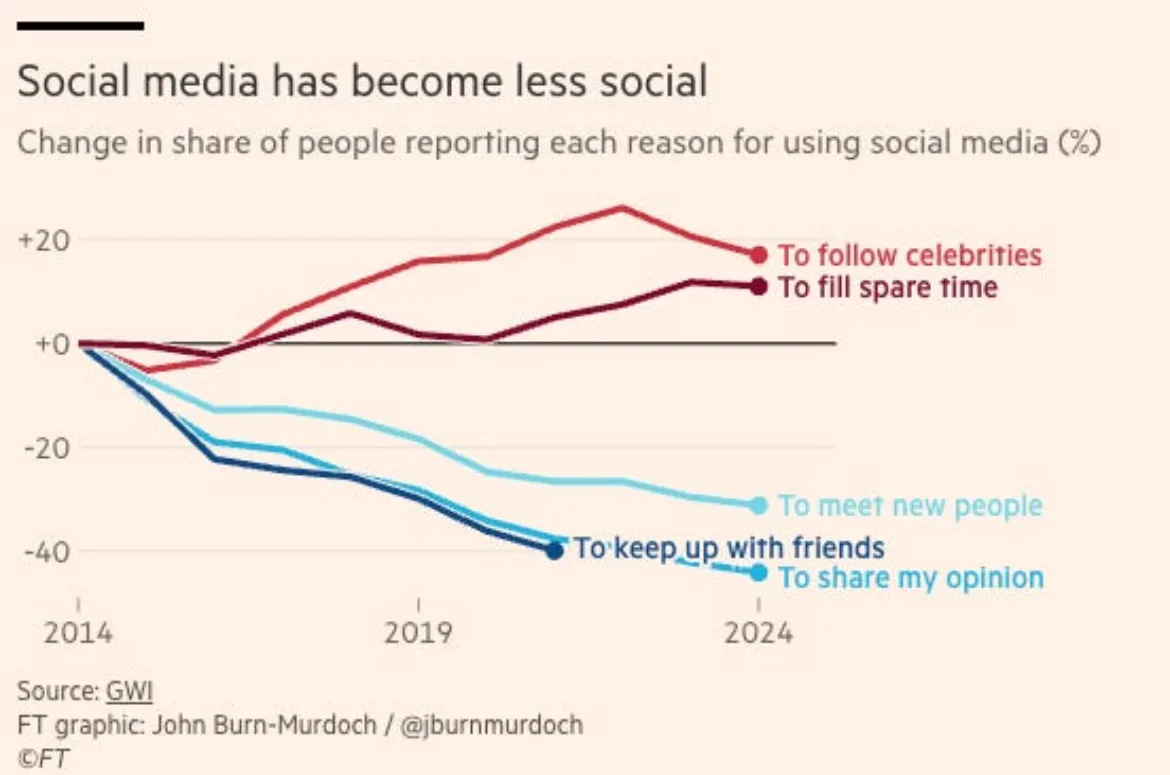
Everything Is Television (Derek Thompson): The money quote and chart:
Social media has evolved from text to photo to video to streams of text, photo, and video, and finally, it seems to have reached a kind of settled end state, in which TikTok and Meta are trying to become the same thing: a screen showing hours and hours of video made by people we don’t know. Social media has turned into television.
This viral creator is actually a brand (Rachel Karten / Link in Bio): I LOVE this social media strategy from Opal, a focus app. Instead of publishing everything through their brand account, they let their social media manager, Olivia Yokubonis, spin up a side account, Olivia Unplugged, that’s “powered” by Opal. Her focus-optimization videos get millions of views for a simple reason: People want to follow people, not brands.
As Olivia put it, “Olivia Unplugged is really an incarnation of Opal. People don’t connect with logos, they connect with people and the stories they tell… If we relied only on a traditional brand account, we’d never reach the scale we’re aiming for.”
I’m the best-selling author of The Storytelling Edge and the fractional CMO at Pepper. Subscribe to this newsletter for new content and storytelling strategies each week.
“Tell stories that sear your ideas into attendees’ minds. The dirty secret is that most conference content sucks. If you have a provocative perspective and great stories to back it up, it’s easy to stand out.” Amen brother!
"IRL is the most underrated content channel" - i love it
Also happy birthday!