

The irony is delicious.
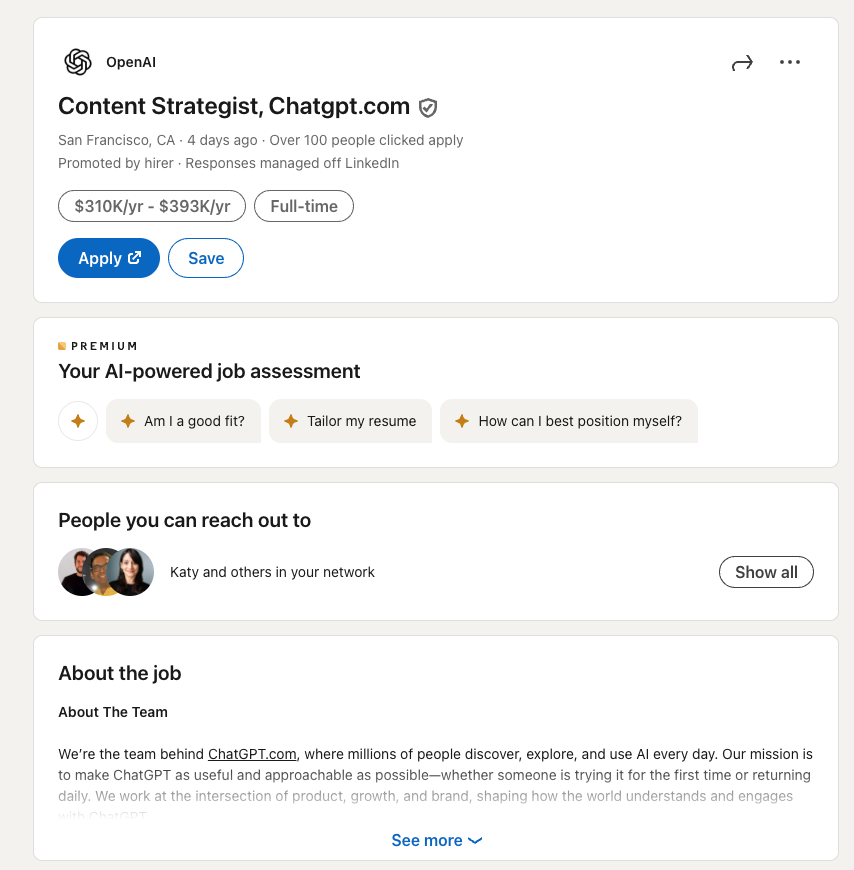
Three years after ChatGPT led everyone on LinkedIn to predict that AI would make writers and content strategists obsolete, OpenAI and Anthropic — creator of ChatGPT competitor Claude — are offering nearly $400K in total comp for content strategy and storytelling roles.
Check out the job descriptions here and here. It’s the exact type of storytelling and communications work that AI was supposed to automate.
So what happened?
Anthropic and OpenAI have realized what smart content people have long known: If you want to connect with people, you need authentic, human storytelling that rises above the sea of AI Slop.
There’s also reason to believe that this won’t change. While AI models have made giant leaps in technical areas like coding, math, and data analysis, their writing and storytelling capabilities have advanced much more slowly due to how they’re trained:
They’re trained on a large volume of bad content that’s poorly written and filled with jargon. That’s why AI loves meaningless babble like “groundbreaking,” “game-changing,” “landscape,” “delve,” and “holistic.”
When an LLM is uncertain, it’s trained to hedge by spitting out extra text, basically like a student bullshitting their way through an answer.
They’re also trained to rate verbose answers more highly.
In other words, AI models are trained to sound like an insufferable junior McKinsey analyst in ways that are surprisingly hard to fix. For OpenAI and Anthropic, brand differentiation is everything; they can’t afford to sound like everyone else. And LLMs contain a vortex of mid that sucks you into the meaningless middle.
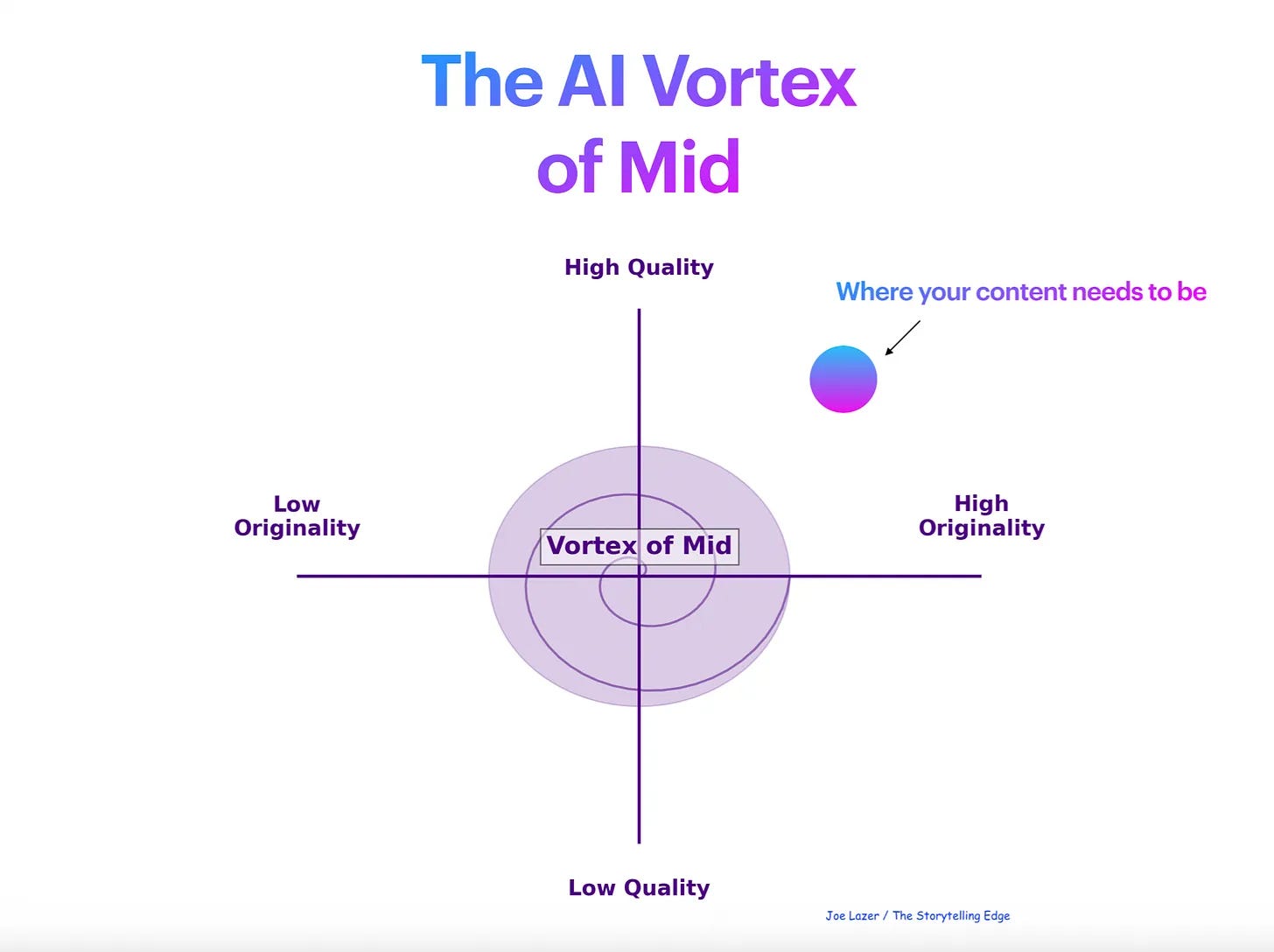
But there’s a simpler truth at play, too. While AI can write, it can never be a storyteller. It will never have the stories and experience to connect with an audience. ChatGPT will never know the trauma, joy, love, hate, and wonder that bind us.
Stories are humanity’s most powerful cognitive and social technology. It’s always been silly to think that’s what we should outsource to the machines.
Vibe coding vs AI slop
I’m working on a larger piece on this, but I think we’re headed for a split in which AI will continue to advance much faster in coding and technical skills than in storytelling and communications.
Part of that is technical and financial. Good code is much easier to objectively define than writing, and with coding, AI can simulate tests of its code to see if it works, thanks to its new reasoning models. Objectively good writing is much more difficult to test and define. LLMs are being forced to make choices about where they focus their improvements, and there’s ultimately more savings for enterprise companies in automating software engineering than in automating storytelling.
The other part is cultural. AI-generated code has earned the bubbly nickname of vibe coding. (Fun!). Meanwhile, AI-generated content has earned the epithet of AI Slop. (Boo!) We have no issue with AI writing our code, but it better stay the hell away from our stories.
The research backs this up. Studies of AI-generated content have consistently come to the same conclusion: When people think a piece of content was generated by AI, they rate it poorly regardless of its quality.
For example, in late 2024, researchers at the University of Florida presented participants with two versions of the same story. One version was written by a human, the other was written by generative AI. Sometimes, they correctly labeled the AI-written story as AI-generated. Other times, they labeled the human-written story as AI-generated. Whenever either story was labeled as AI, people rated it poorly. They hated stories that they thought were written by AI, even if humans actually wrote them. Similarly, researchers at the University of Vienna found that when people believe that an author has used AI to generate content, their perception of the author plummets.
I feel more certain than ever: Storytelling will be the super skill of the AI Age. Even OpenAI and Anthropic have come to realize this. It’s time the rest of America’s CEOs get on board.
If you enjoyed this story, you’ll also like:
Recommended
The Death of the Corporate Job (Still Wandering): This made me spit out my tea this morning:
The most honest person I've met recently was a VP at a tech company who told me: "I manage a team of twelve people who create documents for other teams who create documents for senior leadership who don't read documents. I make £150k a year. It's completely absurd, and I'm riding it as long as I can while building something real on the side."
Untitled Essay (Julieanne Smolinski / The Minimizer): Maybe the funniest essay on parenting you’ll read this year. I sent this to my wife and she was absolutely dying.
After a near unbroken streak of non-participation, my husband volunteered to help with the Fall Carnival out of guilt and almost immediately smashed his body into a charity “wishing well,” which was full of water, and subsequently flooded the rest of the carnival area. Later, when one of the moms bought breakfast sandwiches for the volunteers, one was not allocated for him.
My Once-in-a-Million-Years Love Story (Elizabeth Gilbert / The Cut): Have you read the latest viral essay from The Cut? is the most annoying New York question you can ask… but have you? You really should.
I’m the best-selling author of The Storytelling Edge and the fractional CMO at Pepper. Subscribe to this newsletter for storytelling strategies that will help you stand out in the age of AI.
Interesting post on why AI's attempt at storytelling turns people off!
Hi, I read both job descriptions. They are actually editorial/comm roles for the companies own storytelling and content, not for LLMs.